
How Faimly Farm A2 Ghee Is Made: From Farm to Jar
Share
Share
By the Faimly Farm Team · Our process, from farm to jar
People often ask how our ghee is made. The short answer: slowly, traditionally, and in small batches. The longer answer is a journey that begins with indigenous cows and ends with a sealed glass jar of golden A2 ghee. Here is that journey, step by step.
1. It Starts with Indigenous A2 Cows
Everything begins with the milk. We use milk from indigenous Indian cow breeds, whose milk is the source of A2 ghee. The quality of the milk sets the ceiling for the quality of the ghee — so this first step matters most.
2. Setting the Milk into Curd
Rather than separating cream, we follow the traditional bilona path: the whole milk is cultured and set into curd (dahi). This fermentation step is what defines bilona-style ghee and lays the foundation for its aroma.
3. Churning Curd into Butter
The set curd is churned to separate butter (makkhan) from buttermilk. This curd-churned butter — not directly separated cream — is what we cook into ghee.
4. Slow-Cooking into Ghee
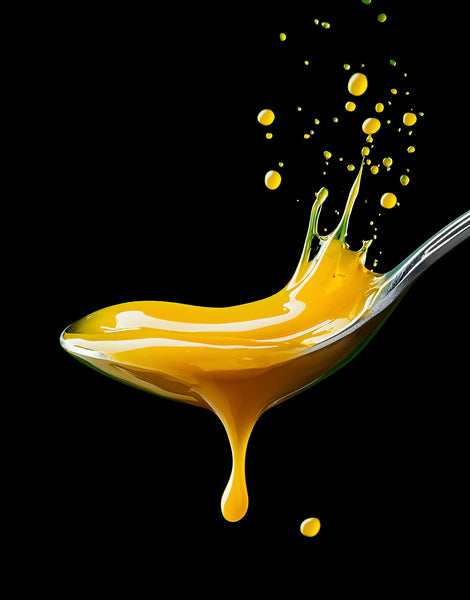
The butter is then slow-cooked over gentle heat. As the moisture evaporates and the milk solids gradually turn golden, the kitchen fills with the characteristic nutty aroma. This slow, watchful cooking is where butter becomes ghee — and rushing it would cost the flavour.
5. Small Batches, Lab-Tested
We make our ghee in small batches rather than industrial volumes, which lets us keep a close eye on every stage. Our ghee is lab-tested for purity and made under our FSSAI licence — tradition backed by checks.
6. Sealed in Glass
Finally, the ghee is filled and sealed — we favour glass for storing ghee, as it does not interact with the contents and helps preserve aroma and freshness. From there it travels to your kitchen.
Why We Do It This Way
The bilona method is slower and more labour-intensive than commercial production. We choose it because it is the traditional way and because we believe it gives a richer, more authentic ghee — the kind Indian kitchens have valued for generations. It is a deliberate choice to favour craft over speed.
The Faimly Farm Promise
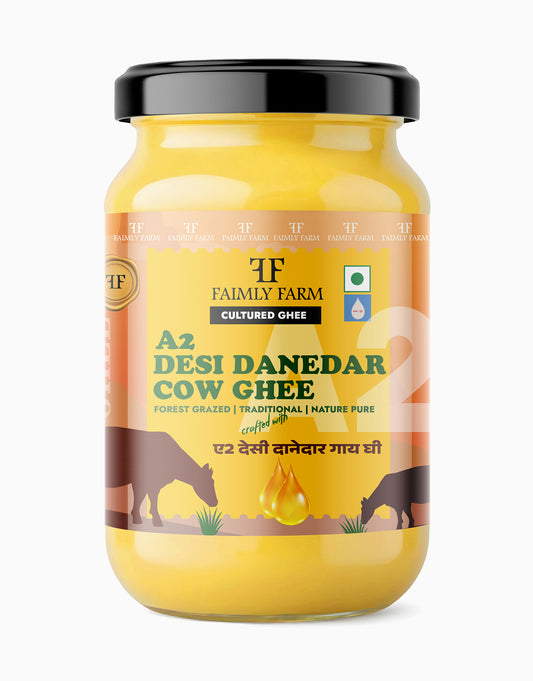
Indigenous A2 milk, the traditional bilona method, small lab-tested batches, and glass packaging — that is our process in one line. Explore our A2 Bilona Cow Ghee or the full A2 Ghee collection.
Frequently Asked Questions
How is Faimly Farm A2 ghee made?
It is made the traditional bilona way: milk from indigenous cows is set into curd, churned into butter, and slow-cooked into ghee, in small lab-tested batches under our FSSAI licence.
Why use the bilona method?
It is the traditional, curd-churned approach associated with richer aroma and texture, and we choose it for authenticity even though it is slower and more labour-intensive.
Is the ghee lab-tested?
Yes. We make ghee in small batches and lab-test for purity, under our FSSAI licence.
Why is the ghee packed in glass?
Glass does not interact with the ghee and helps preserve its aroma and freshness, which is why we favour it for packaging.
What kind of milk is used?
Milk from indigenous Indian cow breeds, which is the source of A2 ghee.
Conclusion
From indigenous cows to a sealed glass jar, our ghee passes through curd, churn, and slow fire — the traditional bilona journey. It is a slower way to make ghee, and that is exactly the point: it is how the aroma, grain, and character of genuine A2 ghee are built.
Bring home traditionally made ghee. Explore our A2 Ghee collection, try A2 Bilona Cow Ghee, and read our bilona vs cream method guide. New customers can use code FIRST10 for 10% off their first order.
Faimly Farm: indigenous A2 milk, traditional bilona batches, lab-tested purity under our FSSAI licence. Learn more about Faimly Farm or contact us.