
A2 Cow Ghee and Inflammation: What the Evidence Actually Says

Share
By the Faimly Farm Team · Last updated June 17, 2026 · Reading time: about 6 minutes
Why Trust This Article
We make A2 cow ghee at Faimly Farm, but we will not claim it treats or cures inflammation — the evidence does not support that, and honesty matters more than a sale. This article gives you a balanced, evidence-aware view so you can decide sensibly. It is general information, not medical advice.
"A2 ghee for inflammation" is a popular search, and you will find plenty of bold claims that ghee is an anti-inflammatory superfood. The reality is more measured. This guide separates what is genuinely supported from what is overstated, so you can understand where A2 cow ghee actually fits.
The Short, Honest Answer
A2 cow ghee is not a proven treatment for inflammation, and no one should rely on it to manage an inflammatory condition. What can be said fairly is that pure ghee contains components — such as butyric acid and fat-soluble vitamins — that are studied in the context of gut and general health, and that replacing heavily processed fats with a quality fat may fit an overall anti-inflammatory dietary pattern. The benefit, if any, comes from the whole diet, not from ghee alone.
The Problem: Superfood Hype vs Evidence
Inflammation is a serious topic, and exaggerated "miracle food" claims can mislead people into relying on a single food instead of proper care. A clear-eyed view is more useful: ghee is a traditional, quality fat that can fit a balanced diet — not a medicine. Treating it as either a cure or a villain both miss the mark.
What Is Actually in A2 Cow Ghee
- Butyric acid: a short-chain fatty acid studied for its role in gut-lining health, which is linked to broader wellbeing.
- Fat-soluble vitamins: vitamins A, E, and K2, with vitamin E in particular known as an antioxidant nutrient.
- Monounsaturated fat: including oleic acid, the same fat found in olive oil.
- Low lactose and casein: often better tolerated by those sensitive to other dairy.
These components are why ghee is studied with interest — but the presence of a nutrient is not the same as a proven anti-inflammatory effect from eating ghee.
What the Evidence Does and Does Not Support
Does not support: that eating A2 cow ghee treats, cures, or reliably reduces inflammation or inflammatory conditions. There is no strong clinical basis for that claim.
Reasonably supports: that overall dietary patterns affect inflammation, and that within a balanced diet, replacing ultra-processed and hydrogenated fats (which can be pro-inflammatory) with a pure, quality fat like genuine ghee is a sensible choice. The lever is the whole pattern, not the single food.
The Ayurvedic Perspective (in Context)
In Ayurveda, cow ghee is traditionally regarded as cooling and nourishing, and is used in many preparations. This reflects long cultural experience and is worth understanding — but Ayurvedic tradition is a different framework from modern clinical evidence, and traditional use should not be read as proof of a medical effect.
An Anti-Inflammatory Diet: Where Ghee Fits
- Emphasise whole foods: vegetables, fruits, whole grains, legumes, and quality proteins.
- Reduce ultra-processed foods and hydrogenated/trans fats.
- Use quality fats in moderation — pure ghee, olive oil — in place of processed oils.
- Mind overall calories and balance, not single "magic" foods.
- For any inflammatory condition, follow medical guidance first.
Common Myths and Misconceptions
Myth: A2 ghee is an anti-inflammatory cure. No food is; ghee is a quality fat that can fit a healthy pattern, not a treatment.
Myth: More ghee means less inflammation. Ghee is calorie-dense; more is not better, and excess calories can work against health goals.
Myth: Ghee is automatically inflammatory because it is saturated fat. The picture is nuanced; quality, quantity, and overall diet matter more than a single label.
Quality and Purity Factors
Whatever role ghee plays, it depends on the ghee being genuinely pure. Adulterated ghee cut with hydrogenated oils adds trans fats, which are associated with poorer health outcomes. Choose A2 milk from named indigenous breeds, the bilona method, lab testing, and an FSSAI licence.
The Faimly Farm Experience
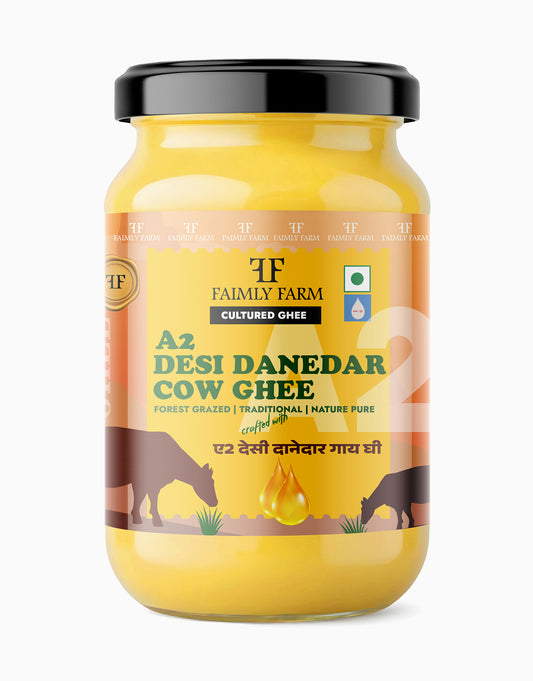
We would rather you choose our ghee for its purity and quality than for an overstated health claim. Our A2 cow ghee is made from indigenous-cow milk via the bilona method, in small lab-tested batches under our FSSAI licence — a clean, quality fat for a balanced kitchen. Explore our Green Grass-Fed A2 Cow Ghee or the full A2 Ghee collection.
Expert Insight
Health researchers consistently stress that inflammation is influenced by overall lifestyle and dietary patterns rather than any single food. In that framework, a pure, quality fat used in moderation can be part of a sensible diet — which is the honest and useful way to think about ghee and inflammation.
Key Takeaways
- A2 cow ghee is not a proven treatment for inflammation.
- It contains studied components (butyric acid, vitamins A, E, K2) but that is not proof of an anti-inflammatory effect from eating it.
- Overall dietary pattern matters most; a quality fat can replace processed fats within it.
- For inflammatory conditions, follow medical advice; use ghee in moderation.
Frequently Asked Questions
Is A2 cow ghee anti-inflammatory?
There is no strong evidence that eating A2 cow ghee reduces inflammation. It contains studied components and can fit an overall balanced, anti-inflammatory dietary pattern, but it is not a treatment.
Can ghee help with inflammatory conditions?
Ghee is not a medicine and should not be relied on for inflammatory conditions. Always follow medical guidance; ghee may simply be a quality fat within a balanced diet.
Does butyric acid in ghee reduce inflammation?
Butyric acid is studied for gut-lining health, but the presence of a nutrient in ghee does not prove an anti-inflammatory effect from eating ghee.
Is ghee better than seed oils for inflammation?
Replacing ultra-processed or hydrogenated fats with a pure, quality fat may suit an anti-inflammatory pattern, but evidence comparing specific fats is mixed. Overall diet matters most.
How much A2 ghee can I have if I am watching inflammation?
A small, moderate amount within a balanced diet. There is no special "anti-inflammatory dose," and a professional can advise based on your health.
Should I use ghee to treat arthritis or other conditions?
No. Do not use ghee as a treatment for any medical condition. Consult a qualified healthcare professional.
Conclusion
A2 cow ghee is a pure, traditional, quality fat — but it is not an anti-inflammatory cure, and honest information serves you better than hype. Within an overall healthy dietary pattern, using a quality fat in moderation in place of heavily processed oils is sensible. For inflammation or any health condition, the right path is professional medical guidance, with ghee playing only the modest role of a good fat in a balanced diet.
Choose ghee for purity and quality. Explore our A2 Ghee collection, try the Green Grass-Fed A2 Cow Ghee, and read our related guides on the honest health benefits of A2 cow ghee and A2 ghee and weight loss. New customers can use code FIRST10 for 10% off their first order.
This article is for general information and is not medical advice. For any inflammatory or other health condition, consult a qualified healthcare professional. Faimly Farm: indigenous A2 milk, traditional bilona batches, lab-tested purity under our FSSAI licence. Learn more about Faimly Farm or contact us.