
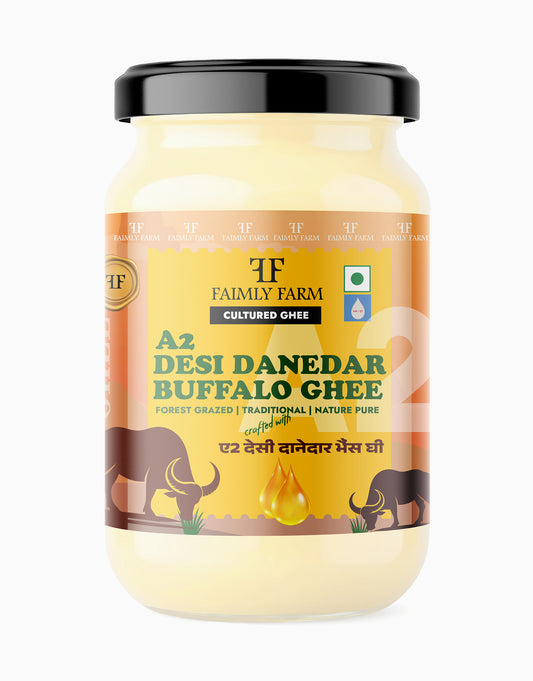
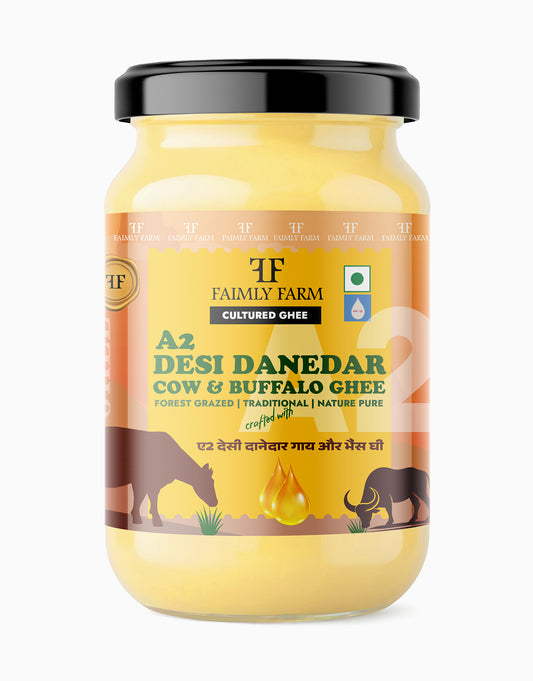
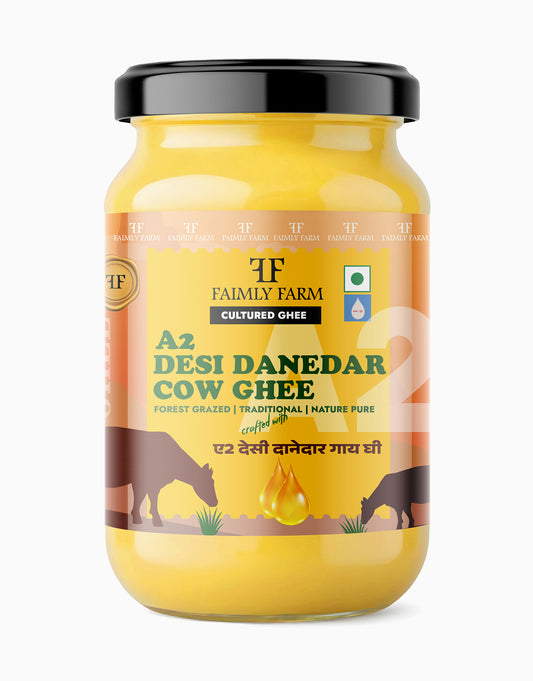

Pure A2 Ghee Buying Guide: How to Choose Genuine Ghee

Share
Choose ghee by checking its declared ingredients, milk source, production method, quantity and supporting evidence. Price, colour, graininess and a brand name do not establish purity on their own. This Faimly Farm checklist helps you compare information rather than rely on a “best” or “purest” ranking.
Keep the claims separate
Bilona describes a production route. An A2 description concerns the milk source. Organic certification is a separate question. Ask what evidence supports each claim instead of assuming that one proves the others. Our bilona, A2 and organic explainer provides a comparison worksheet.
Read the listing and the actual pack
Before ordering, look for a clear product description, ingredients and declared net quantity. When the jar arrives, compare it with the order and inspect the seal, batch details, dates, manufacturer information and storage directions. If something differs, keep the packaging and ask the seller to clarify before using the product.
A licence or registration detail identifies part of the food-business information; it should not be treated as an independent guarantee for every marketing claim on a listing. Use official sources when checking regulatory information rather than relying on a copied logo.
Ask what “lab-tested” covers
If testing is important to your decision, request the relevant report. Check the laboratory, sample identity, dates and tests performed. A report for a different product or an unrelated sample does not automatically establish the properties of your jar. See our guide to reading a ghee laboratory report, including links to FSSAI and NABL.
Compare the same quantities
Divide price by the declared quantity and compare like units: rupees per 100 g with rupees per 100 g, or rupees per 100 mL with rupees per 100 mL. One litre is not automatically one kilogram of ghee. Add delivery and any applicable charges before comparing the final cost.
A larger jar can be convenient, but it is not automatically the best choice for an occasional cook. Match the purchase to your usage and the manufacturer's storage guidance. Our pack-size and price guide shows the calculations.
Use appearance as an observation, not a certificate
Aroma, texture and colour can help describe a product, but cannot by themselves confirm that no adulteration exists. Do not use a melting or refrigeration demonstration as proof of A2 milk sourcing, organic certification or universal purity. If a product seems spoiled or the seal is compromised, contact the seller; do not taste it simply to investigate.
Buying Faimly Farm ghee
The Faimly Farm Organica A2 Cow Ghee Bilona Churned product page lists current pack choices and describes a curd-churned process using indigenous-cow milk. Check the selected variant and checkout for the current price and delivery details. This article does not assert batch testing or organic certification without the relevant documents.
Questions shoppers ask
Which A2 ghee brand is best?
The useful choice depends on your cooking needs, budget and the evidence supplied. A list placing a seller first is not a substitute for checking the actual product. Use the same checklist for Faimly Farm.
Can I identify pure A2 ghee at home?
Home observations do not establish both composition and milk origin. Ask for the relevant analytical and sourcing information.
Is a high price proof of quality?
No. Assess quantity, suitability and evidence separately from price.
Where can I find Faimly Farm offers?
Check the current product page and checkout. Do not rely on an old article's discount code or assume that delivery is free.
Updated 15 October 2026 by Faimly Farm with AI assistance. This is a practical buying checklist, not a batch certificate or independent product review.
Practical guides to explore next
- To distinguish an ingredient description from a finished-product gluten-free assurance and plan shared-kitchen handling, read Gluten-Free Ghee Claims: Ingredients and Cross-Contact.
- To understand what links a pictured farm to a particular ghee batch and request relevant provenance information, read Reading a Farm Story: Separating Photographs from Traceability.