




How to Check Ghee Purity: Seven Checks and Home-Test Limits
Seven practical checks for ghee purity claims, the limits of home observations, and when to ask for laboratory evidence.
By Faimly Farm, with AI assistance · Updated 19 October 2026
To check ghee purity, start with the product identity, traceable purchase details and relevant laboratory evidence. Palm melting, graininess, aroma and refrigeration are not a complete purity certificate. A quick test aimed at one adulterant cannot answer every question about a jar.
This guide replaces earlier home-test instructions with seven practical checks and clearer limits. Do not attempt concentrated-acid tests at home. FSSAI's analytical methods include laboratory equipment and chemical-handling precautions; those procedures should not be turned into improvised kitchen experiments.
Why the distinction matters
There are three different tasks: noticing a concern, identifying what a product claims to contain, and obtaining analytical evidence about a sample. A suspicious observation can justify contacting the seller or a food-safety service, but it does not identify an adulterant by itself. Equally, a reassuring appearance does not establish that all possible adulterants are absent.
Seven checks before accepting a purity claim
1. Record exactly which product you have
Photograph the front and back labels, batch or lot code, date information and purchase receipt. Write down the product name rather than only the brand. This creates a useful record for a seller enquiry or a laboratory discussion; it is not itself proof of composition.
2. Compare the pack with the listing
Read the ingredient description and milk-source wording. If the listing says cow ghee but the received pack describes a blend, ask the seller to resolve that mismatch before assuming the descriptions are interchangeable. Save screenshots of the specific claim you are querying.
3. Separate observations from conclusions
Record colour, aroma or texture as observations, not pass/fail results. “The jar looks grainy” is different from “the jar contains no added fat.” Do not deliberately overheat a sample, taste a suspect product or use a palm-melt or refrigeration result as a verdict on adulteration.
4. Ask what a quick test actually screens for
FSSAI publishes consumer demonstrations for selected common adulterants. Each is a particular screening question, not a universal certificate. Before relying on a result, identify the food, target substance and method it applies to. This guide does not provide chemical test recipes. A negative result for one target should not be rewritten as “100% pure.”
5. Request a report that can be connected to the product
Ask for the laboratory name, sample identifier, relevant dates, test names, methods and results. Then ask how the tested sample relates to the pack being offered. A certificate photograph without the sample details cannot answer that connection. Our guide to reading a ghee laboratory report explains the next level of detail.
6. Keep sourcing and process claims separate
A report about fat composition does not automatically document milk sourcing, churning or organic certification. Ask separately for the evidence relevant to each claim. Read what bilona, A2 and organic labels each mean before treating these terms as substitutes for one another.
7. Escalate a concern without changing the sample
Keep the pack and receipt, and contact the seller or food-safety service. FSSAI's consumer guidance describes approaching a notified laboratory or the food-safety department for testing. Ask the receiving service how to handle and submit the sample before opening, transferring, heating or adding anything to it. Do not send a chemically treated sample without explaining what was done.
A simple claim-checking worksheet
| What you have | What remains to ask |
|---|---|
| A pleasant aroma or grainy texture | What analytical evidence supports the composition claim? |
| A “lab-tested” statement | Which sample, tests, dates and results? |
| A report for a different product | How does it relate to this particular jar? |
| A sourcing or process description | What records support that separate description? |
A message you can send
“I purchased [product name], batch [code], on [date]. Could you explain the evidence supporting [exact claim], share any relevant report, and confirm how it relates to this batch? Please advise the next step if laboratory testing is needed.”
Keep the answer alongside your receipt. If documentation is unavailable, describe the claim as unverified; do not invent either a passing result or a failure.
How to apply this to Faimly Farm
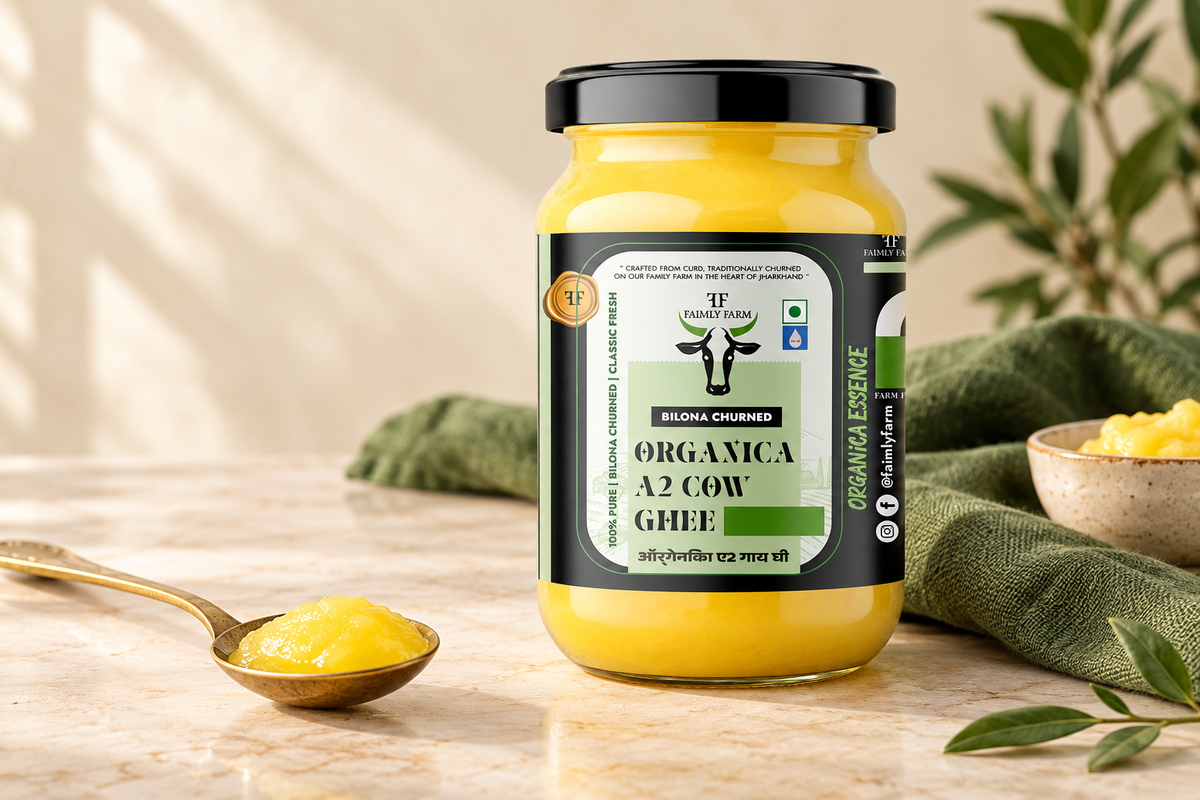
Apply the same checks to our products. For example, the Desi Danedar A2 Cow Ghee Forest Grazed listing is a place to identify the product being discussed, not independent evidence that every claim has been verified. This article does not certify that product or any batch. Learn more about Faimly Farm or contact us with a product enquiry.
Frequently asked questions
Can a palm-melt test prove ghee is pure?
No. A kitchen observation is not a validated all-adulterant analysis. Do not label a jar pure or adulterated solely from how quickly it melts.
Does a negative quick test prove purity?
No. A test aimed at one adulterant does not establish the absence of other substances. Interpret results only within the method's stated purpose and limits.
Should I use hydrochloric acid to test ghee at home?
No. Do not handle concentrated acid or improvise chemical tests in your kitchen. Ask a suitable laboratory for advice.
Does an A2 or bilona label prove purity?
No. Milk sourcing, production method and the analytical composition of a sample are separate questions requiring relevant evidence.
Can consumers arrange laboratory testing?
FSSAI's consumer guidance says consumers can approach a notified laboratory or the food-safety department. Ask for sample submission instructions before sending anything.
Sources and correction note
Sources checked 19 October 2026: FSSAI consumer testing guidance; FSSAI analytical-methods directory; FSSAI dairy analysis manual (2022); and FSSAI consumer adulteration-awareness resources.
Correction: earlier wording presented home observations as purity tests and included an acid-handling procedure. Those instructions and unsupported batch-testing guarantees have been removed. No expert review, independent product testing or batch certification is claimed here. The existing URL and banner are retained.
Continue reading
View all stories
Is Cultured Ghee Probiotic? What the Finished Product Must Show
Cultured does not automatically mean probiotic. Learn what live-culture, strain, amount and finished-product evidence a ghee probiotic claim needs.
Read the story
Cooking for a Guest with Milk Allergy: Check Ghee Before Tempering
Hosting someone with milk allergy? Check ghee in tempering, utensils and serving. A practical preparation checklist with FARE and NIDDK sources.
Read the story
Ghee in a Shared Dish: Estimate Its Contribution to Each Portion
Estimate ghee's contribution to a mixed dish using label values, total additions and portion weights. Understand uneven serving, leftovers and calculati...
Read the storyExplore Faimly Farm ghee
Join the conversation