

Ghee Cost per Recipe: A Kitchen Worksheet for Shared Meals

Share
By Faimly Farm · 17 October 2026
To work out the ghee cost of a recipe, divide the amount paid for the pack by its declared quantity, then multiply by the amount used in the batch. Use the same unit throughout. Divide the batch cost by the number of portions only after defining what one portion means.
This worksheet answers a different question from “Which jar is cheaper?” It helps a household budget for a repeat dish, compare two batch sizes or record a sweet made for a gathering. All prices below are invented arithmetic examples, not current Faimly Farm prices or offers.
Start with three recorded numbers
- Write the price actually paid for the ghee and the date. Decide whether your worksheet includes an allocated share of delivery charges; use the same approach for every comparison.
- Copy the net quantity and its unit from the pack. A jar sold as 500 mL is not automatically a 500 g jar.
- Measure how much ghee you remove for the recipe, including later additions, tray greasing and garnishes. Record unused ghee separately.
For a shared shopping order, do not silently charge the whole delivery fee to one jar. Either exclude delivery from all ingredient comparisons or write down a consistent allocation. This is a household costing choice, not a rule for business accounting.
A complete example using grams
Imagine a 500 g pack costs ₹1,000. The unit cost is ₹1,000 ÷ 500 g = ₹2 per gram. A recipe uses 24 g for the main cooking step and another 6 g for a garnish.
| Entry | Calculation | Example cost |
|---|---|---|
| Main cooking | 24 g × ₹2/g | ₹48 |
| Garnish | 6 g × ₹2/g | ₹12 |
| Whole batch | 30 g × ₹2/g | ₹60 |
| Six equal portions | ₹60 ÷ 6 | ₹10 each |
The ₹10 figure covers only ghee. Rice, flour, vegetables, packaging, energy and other ingredients are separate. If the same batch is divided into four larger portions, the ghee cost is ₹15 per portion; the batch still costs ₹60.
When the pack is in millilitres
Keep a volume-based calculation in volume units: pack price ÷ declared mL × measured mL used. If your recipe is in grams but the pack gives only mL, obtain the relevant net-weight information before claiming an exact gram-based cost. Do not insert a guessed one-to-one conversion or treat the gross weight of a glass jar as the weight of its contents.
Start with our Bilona Ghee Price: Comparing 1 kg, 1 Litre and 500 mL Packs for pack comparisons. For the actual kitchen measurement, use How to Measure Ghee for Recipes: Grams, Spoons and Scaling.
Record waste without confusing it with consumption
Ghee discarded with a pan residue or on a used brush still has an ingredient cost. Include it in the batch's spending record. That does not mean every gram was eaten. A costing sheet and a nutrition estimate answer different questions.
If you set out 40 g but use only 30 g, cost the 30 g used and track what happens to the rest. Do not return a portion contaminated by batter, moisture or used utensils to the storage jar. Deep-frying is a separate costing problem because a reservoir of cooking fat is not the same as the amount incorporated into food.
A worksheet you can copy
Record: dish and version; date; pack quantity and unit; price basis; unit cost; ghee used at each stage; unused amount; total batch cost; actual portion count; and cost per portion. Keep the quantity column separate from notes about taste. Our Passing Down a Family Recipe: Recording Ghee Quantities explains how to capture additions made by eye.
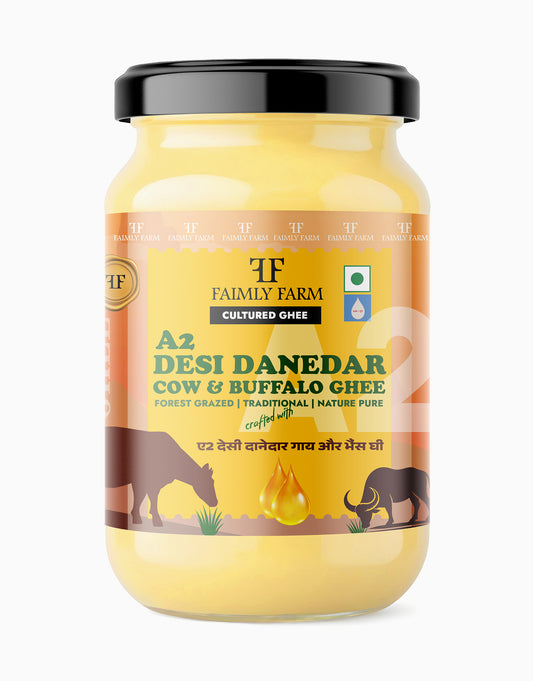
If a blended ghee is your household's choice for the dish, you can enter the selected pack of Faimly Farm Desi Danedar A2 Cow & Buffalo Blend Ghee in the worksheet. Use its current selected-pack price and declared unit. The calculation does not establish purity, nutritional superiority or that the product is the best choice for every recipe.
Frequently asked questions
How do I calculate ghee cost per recipe?
Multiply the cost per gram or per mL by the amount used in the same unit, then add all cooking stages.
Can I cost grams from a 500 mL pack?
Only after obtaining a suitable weight basis. Do not assume 500 mL equals 500 g.
Should I count ghee left in the pan?
Count discarded ghee as an ingredient cost, while keeping it separate from any estimate of the amount eaten.
Prepared with AI assistance. Worked examples and worksheets are editorial tools, not claims of independent testing. Featured banner: AI-generated editorial illustration.
To turn the quantities in your recipe records into a shopping plan, use our household worksheet for estimating how long a ghee jar lasts. It separates ordinary weekly use from occasional larger batches.