

An Animal Study about Ghee Is Not a Human Benefit Claim
A focused reading method for spotting when a result in animals is presented as a proven benefit for people.

By Faimly Farm · 23 October 2026 · Prepared with AI assistance.
Before accepting a ghee-health headline, check whether the experiment involved people, animals or cells. A result in an animal model does not by itself establish the same benefit in people. Keep the study population in every summary you write or share.
Find the participants before the conclusion
Open the original paper and look in the abstract and methods for the species, strain or participant description. A headline may say only “research shows,” while the paper gives a much narrower setting. If you cannot access enough information to identify the model, record that uncertainty rather than filling it in.
The FDA's guidance on substantiating dietary-supplement claims explains that animal research can supply useful biological background, while its ability to predict human effects may be limited or unknown. The guidance concerns US supplements; it is cited here for that scientific distinction, not as Indian ghee labelling law or an approval of any product.
Build a five-line study note
| Question | What to copy from the paper |
|---|---|
| Who or what? | Species or human population; relevant condition or model. |
| What material? | Finished ghee, an isolated component, a mixture or another food. |
| How administered? | The actual route, amount, units and duration. |
| Compared with what? | The control diet or treatment as described. |
| What changed? | The named measurement, including limitations. |
This note makes a missing link visible. For example, “a change in a laboratory measure in rats given preparation X” retains more information than “ghee improves health.” This is an invented wording example, not a description of a particular trial or a finding about Faimly Farm.
Do not turn experimental amounts into spoonfuls
If a paper gives an amount per kilogram of an animal's body weight, keep that unit in your note. Do not multiply it by your own body weight and publish a daily-spoon recommendation. A consumer reading worksheet is not a method for establishing an appropriate human intake.
Similarly, a study using an extracted component does not tell you how much of a retail jar would produce the same exposure. Ask for relevant human evidence and qualified interpretation before attaching a practical health recommendation.
Keep the product link in its proper role
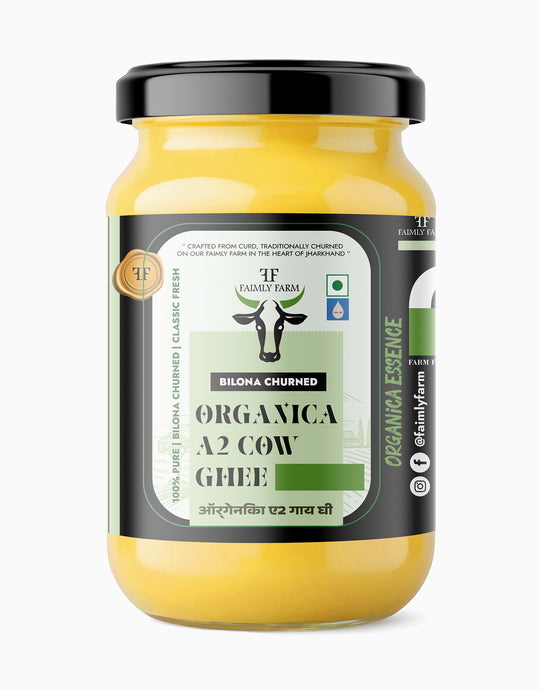
Organica A2 Cow Ghee Bilona Churned is the A2 product referenced by this guide. Its name does not establish that it was the material tested in a paper, or that an animal result transfers to this jar. The link supplies product identification, not a therapeutic recommendation.
For a different mismatch, read why an A2-milk study is not a finished-ghee trial. The population and the food both need to match the question.
Quick questions
Does this make animal research useless?
No. It can help investigate mechanisms and frame further research. The issue is overstating what one kind of evidence establishes.
Does a human study automatically settle the claim?
No. Its design, population, product, outcome and limitations still require review.
Should a headline change my treatment?
Discuss treatment decisions with your clinician. This article is evidence literacy, not medical advice or a systematic review of ghee trials.
Browse Health & Wellness.
Article prepared with AI assistance. Banner: AI-generated editorial illustration, not a photograph of a product pack, kitchen test, family event or historical artefact. No firsthand testing is claimed. Visit the Faimly Farm Journal.
Continue reading
View all stories
Leftover Ghee Rice: Plan Cooling Before Reheating
A rice-specific household routine that starts when cooking ends, with clear cooling, refrigeration and reheating limits.
Read the story
Ghee Batch Numbers: How to Read a Food-Recall Notice
A general guide to matching product and batch details with an official notice, without assuming that every pack of a brand is affected.
Read the story
Keep the Ghee-Jar Spoon Separate from Cooking Utensils
A simple utensil setup that keeps scooping ghee separate from handling raw ingredients and serving food.
Read the storyExplore Faimly Farm ghee
Join the conversation