



Ghee Gift Budget: Calculate the Full Cost per Recipient
Plan regular-ghee gifts with a complete per-recipient budget covering food, presentation, protective packing and delivery, with an original worked example.

By Faimly Farm, with AI assistance · Published 21 October 2026
Budget a ghee gift by its delivered cost per recipient: the selected food, presentation, protective packing, delivery and any charges not already included. Divide shared costs only once, and keep a separate reserve for uncommitted expenses. A lower jar price does not necessarily produce a lower delivered gift cost.
This worksheet helps a household or small team plan several regular-ghee gifts. It supplies arithmetic and questions, not a Faimly Farm quotation, tax opinion or delivery promise. All rupee figures below are invented examples for calculation.
Start with recipients, then choose the pack
Count households or individual recipients according to how you intend to give the gifts. Two people receiving one shared parcel are one gift in this budget. Two separately addressed parcels are two gifts even if both go to the same family. Resolve duplicates before ordering.
Ask whether a dairy food suits each recipient rather than assuming ghee is universally suitable. A recipient who declines food or dairy should have a different gift option; increasing the pack size will not solve a suitability issue. Keep dietary preferences and addresses in a private planning record.
For selection, the established ghee gifting guide introduces pack and presentation decisions. This worksheet adds the financial calculation after you have chosen a suitable option. Verify any commercial claims in older guides against the current pack and checkout.
Build a complete cost row
| Cost field | What belongs here | Double-counting check |
|---|---|---|
| Food | The exact selected variant and number of jars per gift | Do not use a starting price for a different size |
| Presentation | Gift box, wrapping and card if separately charged | Check whether the pack already includes them |
| Transport protection | Outer carton, cushioning and containment where needed | A decorative box may not be transport packaging |
| Delivery | Quoted charge for the actual address and service | Distinguish one office shipment from separate home deliveries |
| Other confirmed charges | Only actual quoted charges not already included | Do not add a tax twice or invent an assumed rate |
| Discount | Only the reduction that actually applies to this order | Do not apply a code again to an already discounted total |
The US Federal Trade Commission's online-shopping guidance recommends checking the full cost including delivery, handling, taxes and other fees. That general shopping principle informs this worksheet; US legal deadlines or remedies are not being applied to an Indian order.
Use these two calculations
Gift subtotal = food + presentation + protective packing + delivery + other additional confirmed charges − applicable discount.
Average committed cost per recipient = total committed campaign cost ÷ confirmed recipient count.
Keep campaign-level expenses separate before allocating them. For example, a single design fee should appear once in the campaign total, not once in the shared-cost line and again on every recipient row. Where delivery costs differ, retain each actual row even if you also report an average.
A worked example for eight recipients
Suppose an illustrative gift contains food costing ₹800, presentation costing ₹60, protective packing costing ₹40 and delivery costing ₹100. Assume these example amounts already include all applicable charges and no discount applies. This is not current Faimly Farm pricing.
- Per recipient: ₹800 + ₹60 + ₹40 + ₹100 = ₹1,000.
- Eight gifts: 8 × ₹1,000 = ₹8,000.
- One shared sample expense: ₹200 for the whole project.
- Total committed amount: ₹8,200; average per recipient: ₹8,200 ÷ 8 = ₹1,025.
If the overall spending cap is ₹9,000, the uncommitted balance is ₹800. That balance is not automatically a predicted replacement cost or money you must spend. Recalculate after a quote changes or another recipient is confirmed.
Compare quotes on the same basis
For each quotation record the product name, pack size, jars per gift, gift count, included presentation, protective packing, delivery destinations, validity date and payment terms. A quote for eight gifts sent to one office cannot be fairly compared with a quote for eight separate residential shipments without adjusting the delivery scope.
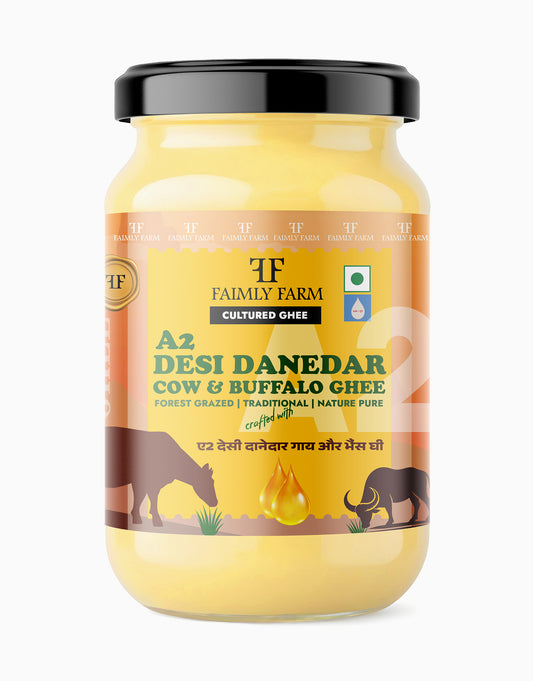
For regular cow ghee, Faimly Farm Shuddh Desi Cow Ghee is a current culinary product reference. Use the exact variant and final checkout or written quote in your worksheet. Linking this single product does not mean gift wrapping, a presentation box, bulk terms or multi-address dispatch are included. Its product name is not independent proof of purity or health benefits.
If comparing volumes or masses, use the same unit. The ghee pack-unit comparison guide explains why 1 kg and 1 litre are different quantities. Its unit method is useful across product ranges; its A2 or bilona examples do not reclassify regular ghee.
Set an approval point before paying
- Confirm the recipient count and food suitability.
- Save the exact product, selected variant and current quoted total.
- Confirm what the presentation and shipping charges include.
- Check delivery to the actual destinations, rather than assuming a national coverage claim.
- Record the approved ceiling, committed total and remaining balance.
- After dispatch, reconcile actual invoices and delivery charges with the estimate.
For the separate physical packing task, use the ghee-gift courier checklist. It was written around A2 gifts; its carrier-check and packing questions can inform a regular-ghee parcel without implying identical products or services.
Keep a short reconciliation record
Use columns for recipient code, selected product, planned cost, actual cost, difference and reason. A private code is sufficient on a shared budget sheet; keep full addresses in the dispatch record. Record an extra delivery charge as an actual expense when confirmed, not as a retroactive change to the original estimate.
Also separate jars bought from gifts delivered. Spare jars remain inventory until assigned. If you bought ten jars for eight recipients, dividing the entire purchase by eight gives the campaign's current cost per recipient, while dividing by ten gives cost per jar. Both may be useful, but label the calculation clearly.
Frequently asked questions
Should my per-person budget include delivery?
Yes, if you are measuring what the gift will cost you to deliver. Keep the food price visible separately so quotes remain easy to compare.
Can I assume a twin pack includes two gift boxes?
No. Verify the actual contents and packaging. The name alone does not establish separately giftable units.
Should I count a coupon before checkout?
Keep it provisional until the code is accepted for the selected products and order. Budget using the confirmed total before committing.
Is a reserve the same as a mandatory fee?
No. It is an uncommitted part of your spending cap. Actual charges require confirmation.
Does a larger pack always make a better-value gift?
No. Consider the recipient's use, suitability, packaging and delivered total. A lower cost per unit does not by itself establish a better fit.
Sources and scope: Faimly Farm catalogue and public product page checked 21 October 2026; FTC online-shopping guidance checked the same date. Calculations are original hypothetical examples, not quotations. Banner: AI-generated editorial illustration. Explore Gifting & Festivals or the Faimly Farm Journal.
Related practical questions
These focused guides expand on the task discussed above.
Continue reading
View all stories
An A2 Ghee Gift That Is Easier to Unwrap: Plan the Outer Layers
Choose manageable outer wrapping and information formats while preserving the sealed A2 ghee pack.
Read the story
When a Ghee Gift Must Change: Confirm the Substitution in Writing
Control changes to the product, pack or gift insert before dispatch without inventing seller policies.
Read the story
Approve a Ghee Gift Sample Before the Bulk Order: A Checklist
Record exactly what a sample approval covers and what still needs written confirmation.
Read the story
Join the conversation